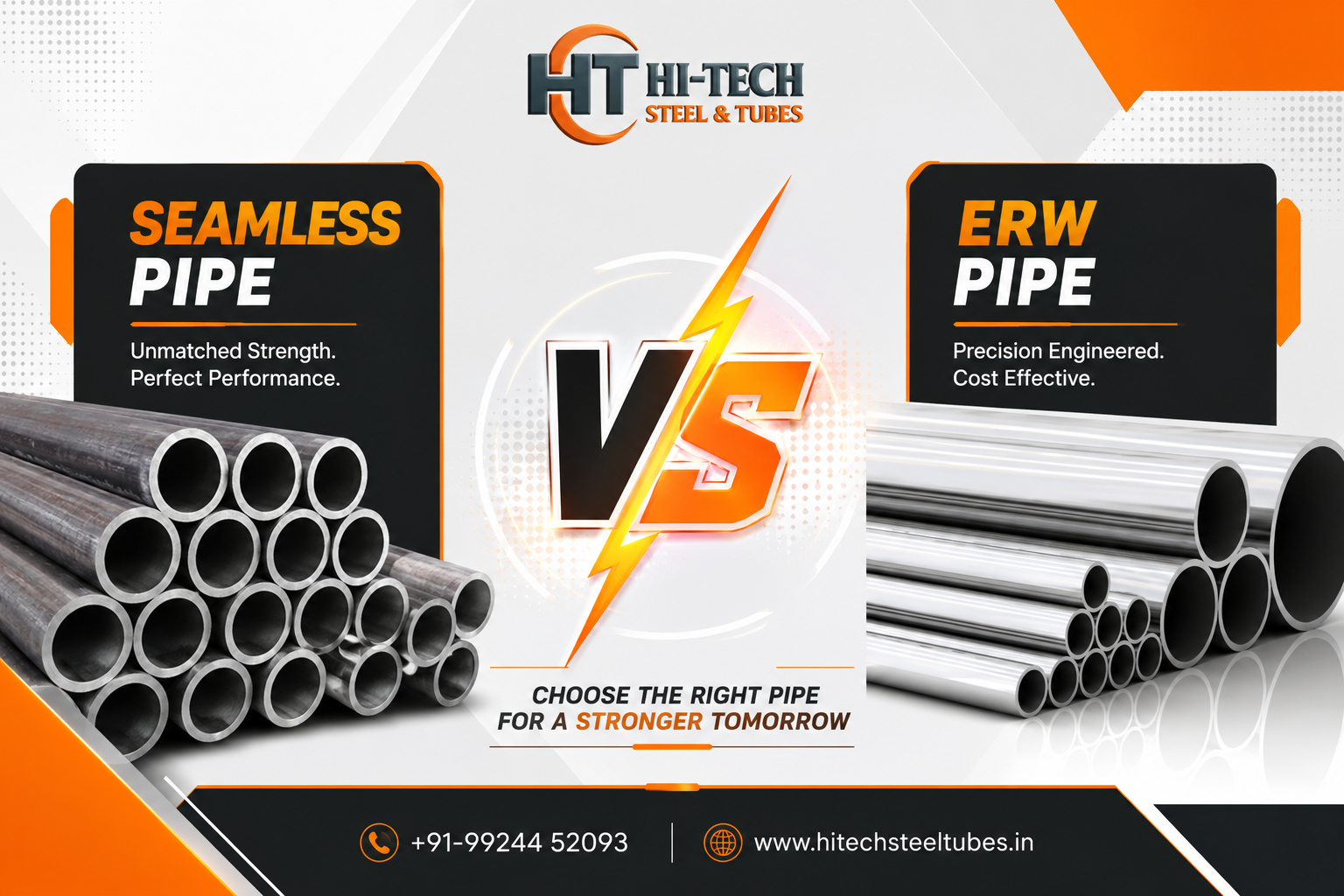
Seamless Pipe vs ERW Pipe: Which Steel Pipe Is Better for Industrial Applications ?
At Hi-Tech Steel & Tubes, we are committed to delivering top-notch Seamless Pipe , ERW pipes and other related s to meet the diverse needs of industries worldwide but Choosing between seamless pipe vs ERW pipe is one of the most important decisions for industries that depend on reliable piping systems. While both are widely used across manufacturing, oil & gas, construction, power plants, and process industries, each offers distinct advantages based on pressure requirements, operating conditions, budget, and project specifications.
If your application demands high-pressure steel pipe performance with excellent structural integrity, seamless pipes are often the preferred option. On the other hand, if cost-efficiency, dimensional accuracy, and large-volume availability are priorities, ERW pipes can deliver outstanding value.
What Is the Difference Between Seamless Pipe and ERW Pipe?
At Hi-Tech Steel & Tubes, Seamless pipes are manufactured without any welded joint, while ERW (Electric Resistance Welded) pipes are produced by rolling steel sheets and welding their edges using electrical resistance.
Because seamless pipes do not contain a weld seam, We generally offer superior performance under high pressure and extreme temperatures. ERW pipes, however, have significantly improved manufacturing quality over the years and are now widely accepted for many industrial applications.
Understanding Seamless Pipes
A seamless pipe is produced by heating a solid steel billet and piercing it to create a hollow tube. Since the manufacturing process eliminates welding, the pipe has a continuous structure throughout its length.
Key Features
- Excellent strength under high pressure
- Uniform material structure
- High resistance to mechanical stress
- Better performance in elevated temperatures
- Suitable for critical industrial operations
In our company, seamless pipes are commonly manufactured according to recognized ASTM pipe grades, ensuring consistent quality and compliance with international standards.
What Is an ERW Pipe?
An ERW pipe is manufactured from rolled steel coils. The strip is formed into a cylindrical shape, and the edges are fused using electric resistance welding without filler material.
Modern manufacturing technologies have greatly enhanced weld quality, making today's welded steel pipe suitable for numerous commercial and industrial applications.
Key Features
- Excellent dimensional accuracy
- Smooth surface finish
- Cost-effective ion
- Available in longer lengths
- Ideal for medium-pressure applications
Seamless Pipe vs ERW Pipe: Major Differences
| Feature | Seamless Pipe | ERW Pipe |
|---|---|---|
| Manufacturing | Solid billet pierced into pipe | Steel coil electrically welded |
| Weld Seam | No | Yes |
| Pressure Capacity | Very High | Medium to High |
| Strength | Superior | Very Good |
| Temperature Resistance | Excellent | Good |
| Cost | Higher | Lower |
| Dimensional Accuracy | Good | Excellent |
| Availability | Moderate | High |
| Best For | Critical industrial services | General industrial piping |
Which Pipe Performs Better Under High Pressure?
When discussing seamless pipe vs ERW pipe, pressure handling is often the deciding factor.
Seamless pipes are engineered to withstand:
- High internal pressure
- Thermal expansion
- Mechanical stress
- Cyclic loading
- Corrosive industrial environments
This makes them the preferred high pressure steel pipe solution for:
- Refineries
- Petrochemical plants
- Power generation
- Hydraulic systems
- Boiler installations
- Offshore projects
ERW pipes are also suitable for many medium-pressure systems, especially where operating conditions remain stable.
Which Pipe Is More Cost-Effective?
Pricing depends on several factors, including raw material costs, manufacturing complexity, pipe size, wall thickness, and applicable standards.
Generally:
- ERW pipes cost less due to simpler manufacturing.
- Seamless pipes require more processing, increasing ion costs.
For projects involving long-distance pipelines, structural fabrication, water supply, or general engineering, ERW pipes often provide better value without compromising performance.
However, choosing a lower-cost option for critical pressure applications can lead to higher maintenance expenses and operational risks over time.
Applications of Seamless Pipes
Seamless pipes are widely used where safety, durability, and pressure resistance are essential.
Common Industries
- Oil and gas
- Chemical processing
- Thermal power plants
- Nuclear facilities
- Boilers
- Heat exchangers
- High-pressure hydraulic systems
- Pharmaceutical manufacturing
- Fertilizer plants
Their exceptional reliability makes them a preferred choice for demanding industrial environments.
Applications of ERW Pipes
Modern welded steel pipe s serve numerous industrial sectors.
Typical applications include:
- Water transportation
- Fire protection systems
- Structural engineering
- HVAC systems
- Agriculture
- Construction
- Furniture manufacturing
- Low and medium-pressure pipelines
- Industrial fabrication
ERW pipes also offer excellent consistency in dimensions, simplifying installation and welding.
How Do ASTM Pipe Grades Affect Pipe Selection?
Choosing the correct ASTM pipe grades is just as important as selecting the manufacturing process.
Some commonly used grades include:
ASTM A106
Suitable for high-temperature seamless carbon steel applications.
ASTM A53
Available in both seamless and welded versions for mechanical and pressure services.
ASTM A333
Designed for low-temperature service.
ASTM A335
Ideal for alloy steel applications involving elevated temperatures.
Selecting the appropriate ASTM grade ensures compatibility with pressure ratings, corrosion resistance, operating temperatures, and industry regulations.
Carbon Steel Pipe: Why It Remains the Industry Standard
A carbon steel pipe continues to dominate industrial piping because it offers an excellent balance of strength, durability, weldability, and affordability.
Benefits include:
- High tensile strength
- Long service life
- Excellent machinability
- Wide ASTM availability
- Suitable for multiple industries
- Easy maintenance
Whether manufactured as seamless or ERW, carbon steel remains one of the most trusted piping materials worldwide.
Factors to Consider Before Choosing Between Seamless and ERW Pipes
Every project has unique technical and commercial requirements.
Evaluate the following before making a purchase:
Operating Pressure
High-pressure systems generally benefit from seamless construction.
Working Temperature
Extreme temperatures require pipes with superior structural integrity.
Budget
Large-volume projects often favor ERW pipes for cost savings.
Industry Standards
Always verify compliance with required ASTM specifications.
Fluid Type
Consider corrosion, abrasiveness, and chemical compatibility.
Installation Environment
Underground, offshore, or high-vibration installations may require seamless solutions.
Common Mistakes Buyers Should Avoid
Many procurement teams focus only on price, overlooking long-term operational performance.
Avoid these common mistakes:
- Selecting pipes without verifying ASTM certification
- Ignoring pressure ratings
- Choosing unsuitable wall thickness
- Buying from unverified suppliers
- Overlooking corrosion requirements
- Failing to match pipe specifications with application demands
Working with an experienced industrial pipe supplier helps minimize these risks and ensures compliance with project standards.
Why Choosing the Right Industrial Pipe Supplier Matters
Beyond quality, your supplier plays a critical role in project success.
A reliable industrial pipe supplier should offer:
- Certified ASTM-compliant s
- Consistent quality assurance
- Wide inventory availability
- Custom sizes and specifications
- Technical consultation
- Timely delivery
- Competitive pricing
- Responsive after-sales support
These factors can significantly reduce project delays and lifecycle costs.
Expert Insight: Which Pipe Should You Choose in 2026?
There is no universal winner in the seamless pipe vs ERW pipe debate. The right choice depends on your application's technical requirements.
Choose seamless pipes when:
- Operating under high pressure
- Handling high temperatures
- Safety is mission-critical
- Long-term durability is essential
Choose ERW pipes when:
- Budget optimization is important
- Medium-pressure performance is sufficient
- Large quantities are required
- Structural accuracy is a priority
Modern manufacturing has narrowed the performance gap considerably, making ERW pipes an excellent option for many industrial projects while seamless pipes continue to lead in critical service environments.
Conclusion
Understanding the differences in seamless pipe vs ERW pipe enables engineers, procurement teams, and industrial buyers to make informed decisions that balance performance, safety, and cost. While seamless pipes remain the preferred choice for demanding, high-pressure environments, ERW pipes provide exceptional value for a wide range of industrial and structural applications.
By evaluating pressure requirements, operating conditions, applicable ASTM pipe grades, and long-term maintenance costs, businesses can select the most suitable piping solution for reliable and efficient operations. Partnering with an experienced supplier ensures access to certified s, technical guidance, and dependable support throughout your project.
FAQs
1. Which is stronger: seamless pipe or ERW pipe?
Seamless pipes are generally stronger for high-pressure and high-temperature applications because they have no welded seam.
2. Are ERW pipes suitable for industrial use?
Yes. Modern ERW pipes are widely used in construction, water systems, structural projects, and medium-pressure industrial applications.
3. Which ASTM pipe grades are commonly used?
Popular grades include ASTM A53, ASTM A106, ASTM A333, and ASTM A335, depending on pressure, temperature, and application requirements.
4. Is a carbon steel pipe available in both seamless and ERW types?
Yes. Carbon steel pipe is manufactured in both seamless and ERW forms to meet different industrial requirements.
5. How do I choose the right industrial pipe supplier?
Look for a supplier with ASTM-certified s, strong quality control, technical expertise, customization capabilities, reliable inventory, and prompt delivery.
Read more:- The Importance of Choosing the Right Steel for Your Project

